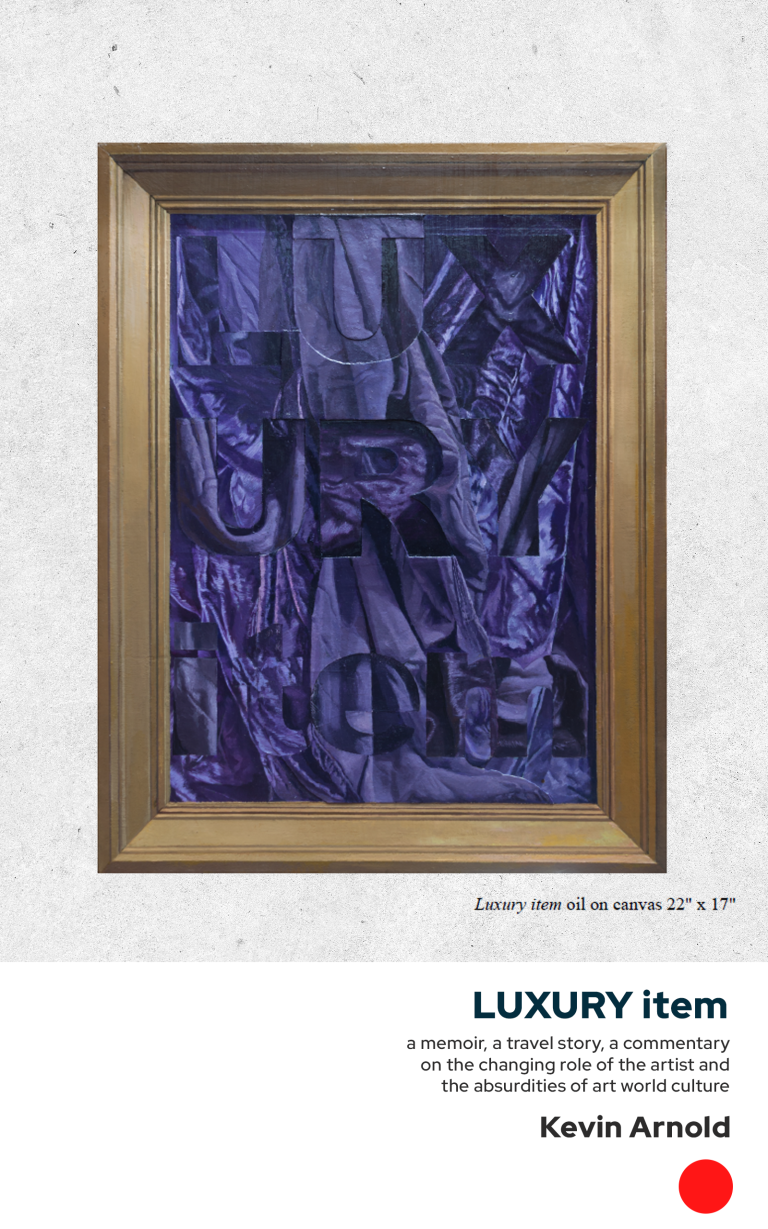
LUXURY item
Disclaimer
Conversation Highlights
LUXURY item is a conversation. It’s a collection of statements, stories, and criticisms written by me and read by you. It’s a window into a very specific time from 2022-2024, post-COVID, pre-election, a point when we were aggressively unlearning past lessons and contemplating the inevitable sequel to our political future. For me, these two years were a crossroads. Somewhat disillusioned and wholly frustrated with what I considered my life’s journey as an artist and painter, I was looking for a new direction. Not an easy task when you’ve tied your identity to that thing you do; nevertheless, I am an artist first and foremost. Creativity is the driver; painting was just the vehicle that got me here.
For those of you who know me personally, friends, artists, and colleagues alike, you are well aware that subtlety is not one of my attributes. You will more than likely disagree and possibly be offended by much of my candor and my critique. If this is the case, remember we’re all family here. We can agree to disagree on any number of topics, but we cannot deny the fact that things have not been going well. And maybe, just maybe, the way we, as artists and Art Market Academia in general, have routinely confronted such challenges has played a much larger role than we care to admit. Let’s face it, as artists we’ve become a bunch of banana-wielding bohemians showing up to a sword fight.
Yes, this book is about artists, but not exclusively. Yes, it’s about art but not specifically. At the heart of it all, this book is about hope. Searching for hope doesn’t mean you’re necessarily hopeless. You can still be hopeful in light of despair while accepting the reality that all hope will be lost without it. But we cannot achieve our greater good without a little self-evaluation. It’s how we evolve for the better. This is my story as the backdrop to our story. Chronicling my past and the circumstances that influenced my journey while posing some heavy questions for you and me in the process.
LUXURY item, How and Why?
LUXURY item came about during a very specific time in my life, from 2022 to 2024. As everyone recalls, we were coming out of a pandemic, still reeling from the reality of our predicament, and, like many of you, I was trying to process it all, what we lived through, the lessons learned, the mistakes quickly forgotten, and where our society was heading as a result.
As people, it’s easy to get frustrated, bogged down in the cynicism of our time, and retreat into places of comfort, whether that’s our home, studio, our tribes, or those hermetically sealed digital spaces we create as bubbles to filter out what we don’t want to see or hear.
As a way of coping as an artist, I felt the need to address those concerns, that criticism I was having, by directing it into my work, my studio. I had done this before through imagery and various approaches to narrative painting that might have touched on an issue of concern, but those messages were always veiled in my craft, my skills as a painter, to portray the things I wanted to depict.
Around 2021, still neck-deep in COVID, I began inserting text into my paintings to both reference the image, or a particular topic, and spark curiosity about its meaning in context. I first debuted the work in 2022 at a solo show in San Francisco, then in a few group shows in the South and Northeast. It received a positive response overall, but for me, it still wasn’t grabbing the bull by the horns. I needed to say some things, a lot of things, directly and honestly, outside the gallery walls. I needed to write it, to state my viewpoint as someone who felt like both an insider and an outsider.
This wasn’t my first attempt. Writing had always been something of a practice. Just after grad school in 2011, I had a short-lived job writing art reviews for a regional news, business, and politics journal. It wasn’t until a few years later, after I met Sarah, my future wife, who was also a travel nurse at the time, that we began traveling coast to coast. By 2015, I was writing short essays documenting our travels, experimenting with styles and ways to tell those adventures and the people we met along the way. One such essay would later be published in “Black Cat Art Journal” out of Brooklyn, and another would be the basis for my published artist statement in “New American Paintings” in 2017
I had no real plans for what I wanted to do with this collection of essays. Still, Sarah kept encouraging me, saying the writing was good and that “you should include these in some kind of book form.” But I didn’t really think much about it until after the text-based show in 2022. That’s when I said, OK, something has to give.
I was at a crossroads. Frustrated, disillusioned, and somewhat jaded by the idiocracy we were experiencing as a nation. I needed a change in direction; I was tuning that dial, trying to find a new frequency, so I thought, “Why not write about it?” Why not write about this journey as it unfolds, while writing about the journey that led me here? This way, I could take the reader on this journey with me, through the questions I posed and the choices I made, good and bad. My story as the backdrop to our story.
I am not a writer. I am an author. Just as being a painter doesn’t necessarily make you an artist. I am a painter who put down my brushes to write a book and, in doing so, set out on a journey to find new purpose.
It’s not easy when you’ve tied your identity so tightly to that thing you do; nevertheless, I am an artist first and foremost. Creativity has always been the driver; painting was just the vehicle that got me here.
For those of you who know me personally, friends, artists, and colleagues alike, you know that subtlety isn’t one of my attributes. You’ll likely disagree and, at times, be offended by much of my candor and critique. If so, remember we’re all family here. We can agree to disagree on any number of topics, but we cannot deny that things haven’t been going well. We stand on the precipice of social/political/environmental collapse, and maybe, just maybe, the way we, as artists (and art market academia in general), have traditionally confronted such challenges has been rendered impotent by the very system that sustains us.
Let’s face it, as artists we’re a bunch of banana-wielding bohemians showing up to a sword fight.
Yes, this book is about artists, but not exclusively.
Yes, it’s about art, but not specifically.
At its heart, this book is about hope. Searching for hope doesn’t mean you’re necessarily hopeless. We can remain hopeful in the face of despair while accepting that, without it, all hope will be lost. But we cannot achieve our greater good without a little self-evaluation in the process. It’s how we evolve for the better. This is my story, the backdrop to ours. It chronicles my past and the circumstances that shaped my journey, while posing some heavy questions for you, us, and me.
Publishing Process
Ok so let’s talk about the publishing process. I knew going in that choosing traditional publishing methods, like finding a literary agent and pitching to a publisher, would be a massively daunting task. While the traditional methods do have their advantages, they come with more caveats than I was willing to take on. I had two major strikes against me.
First, I knew going in that a memoir by someone virtually unknown in the art and literary world would be of very little interest to a publisher. Second, multiple agents had already told me that a book about the art world’s inner workings would interest few readers. But, as it turns out, this book is about circumventing the traditional venues for art and literature. I was more interested in taking this power away from the gatekeepers and taking more control over my product and what I wanted to say.
The gallery world is challenging enough for an artist, but I knew those ropes well. Taking on the literary world was a much different beast altogether. Beyond being frustrated that agents were less than willing to take on such a loaded topic, it was more disconcerting that they cared more about my social media following and what “my” marketing plan would be if and when they decided to pitch me to a publisher.
Excuse me, you said my marketing plan? Isn’t that your job? As I said, I believe we as artists have more power in our court than ever before, and in the world of digital marketing, when an artist can become the business of themselves, why is it that artists are still paying a 50% commission fee to a gallery and publishers offering the bare minimum in royalties? If I am actively marketing myself, and/or your gallery or publishing house, shouldn’t we be renegotiating my worth?
This falls within the absurdities of the art-market culture I so adamantly oppose. Just as I talk about independently organizing and promoting my own art exhibitions without paying to play for a gallery, I too wanted this book to follow the same course. It only makes sense.
That said, choosing between self-publishing and hybrid was a massive hurdle, and even though I chose a reputable hybrid publisher, I still had to relinquish control and rely on their process and contractual agreements to produce this work.
Lessons Learned
While they might provide an editor, writers beware. They are only contractually obligated to fulfill so many rounds of editing. For me, this meant “two” rounds. Anyone who has ever anguished over writing knows that once you read something so many times, it becomes harder to see the most obvious mistakes. The mind has a way of filling in the gaps between what you mean to say and what you actually wrote. My first and biggest mistake was trusting the process and the editing team. I realized this midway through the process, when I kept running into miswordings and blatant misspellings long after editing, well into formatting.
As is the case, this continues to be a work in progress.